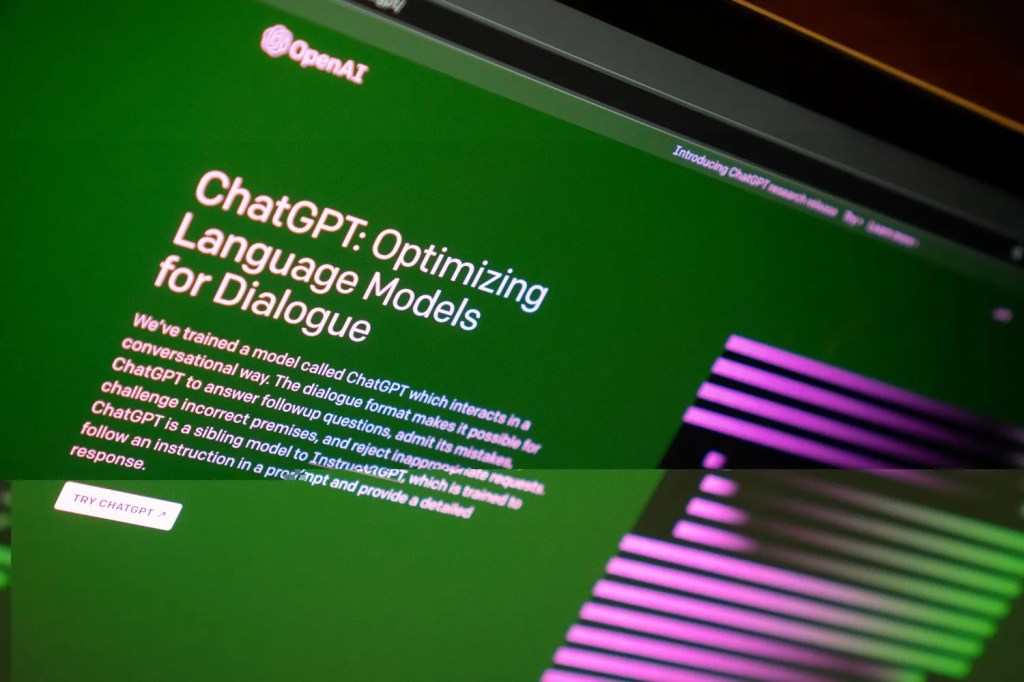
Everyone is currently talking about ChatGPT. The chatbot powered by artificial intelligence (AI), developed by OpenAI, has surpassed 100 million users in just two months, making it the fastest-growing consumer application in history. In order to make ChatGPT more precise in its responses more factually resilient, OpenAI has been working releasing novel improvements as the number of users keeps growing.
It is very amazing how widely popular the chatbot has become. The AI-powered chatbot received 13 million unique visitors daily in January, according to a UBS study. One of the most well-known social media platforms in the world, TikTok, took about nine months from its release to reach the 100 million monthly active user threshold. Instagram, which is owned by Meta, usually always posts new content new updates and features, took two-and-half years to reach the number.
Let’s try to understand what it is about this chatbot that sets it apart from the competition and challenges the authority and supremacy of search engine giant Google before we look at the updates.
Why is ChatGPT famous?
People are using this tool because of its clear benefits: it is an AI that can produce responses that are almost human-like to any questions the user may have. Frequently, the response is well-organized and packed with specific information.
ChatGPT, which is based on Generative Pre-trained Transformer (GPT), is essentially a neural network learning model that may be used to train a machine to carry out tasks related to natural language processing (NLP).
Simply defined, the neural network is essentially a learning algorithm that allows the chatbots resemble the brain and understand human languages as they are spoken or typed, while the GPT enables this new chatbot to react in a conversational manner.
Yet, despite all the hullabaloo, this tool is still a work in progress.
Several have noticed issues with its responses, particularly in terms of factual accuracy given that the information is only up to 2021. This means that inquiries like “who won the FIFA World Cup 2022?” and similar ones that would be related to events after it cannot be accurately answered by the chatbot.
Concerns have also been raised about how it could be misused to produce malware or phishing emails, two of the most significant negative aspects of AI chatbots that researchers have been able to identify.
Updates are therefore even more crucial before it develops into the de facto digital assistant or search engine.
All the important ChatGPT updates
ChatGPT Plus
OpenAI published a blog post on February 1 announcing the debut of ChatGPT Plus. The ChatGPT pilot membership package, which costs USD 20 per month, will grant customers access to the platform even during periods of peak usage, as well as quicker response times and priority access to new features and enhancements.
In the first phase, the premium service was made available to users in the US. “People from our waitlist” will begin receiving invites, according to OpenAI, during the next few weeks. Also, the service will be expanded to new nations and areas.
Contrary to “ChatGPT Pro,” which will be a much improved and upgraded version of the current chatbot, ChatGPT Plus is not the same thing.
Improved factuality and maths capabilities
On January 30, 2023, OpenAI updated the ChatGPT model with increased factuality and mathematical ability in response to criticism that it provided incorrect answers to arithmetic questions.
Experts have already discovered that this chatbot prototype has not always been accurate when it comes to mathematics, despite the fact that it is unclear exactly how the upgrade is altering the responses by ChatGPT.
As a result, the timely upgrade essentially means that the AI chatbot will be able to provide more accurate answers to questions involving computations. This makes ChatGPT even more beneficial for academics and working people in sectors like data science and statistical analysis, among others where crunching numbers is a crucial duty.
Deedy Das, the original engineer at Glean, discovered that despite the upgrade, ChatGPT failed to provide accurate answers to simple mathematical questions
In contrast, the AI chatbot “crushed the math with calculator section of a 2020 SAT and only made two mistakes,” according to Rizz co-founder and CEO Charis Zhang.
In response to a user’s comment about ChatGPT making more mistakes, Zhang stated that the chatbot “suspiciously” provided the correct response without providing an explanation for many practise issues.
I wonder whether it was designed for some test banks to know the choices but not the rationale behind the correct ones. penned Zhang.
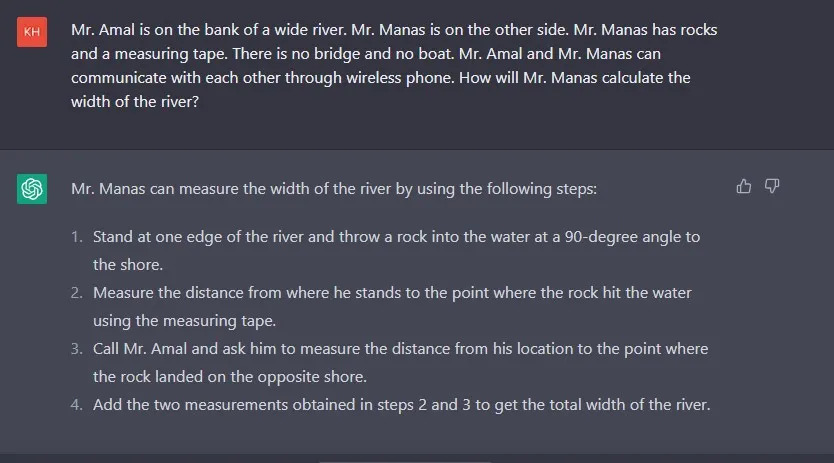
A difficult mathematical problem may be beyond the capabilities of ChatGPT, in addition to simple mathematical problems.
The user questioned the chatbot about a trigonometry problem in the example below. The answer provided by ChatGPT appears to be incomputable. In fact, it is not even necessary to “throw a rock” in order to determine the river’s breadth.
Stop generating
The lengthy replies were rather frustrating, even though Open AI quickly gained notoriety for its prompt and human-like responses. A capability to suspend text generation was added to the chatbot to address this issue.
According to customer feedback, OpenAI introduced the option to discontinue generating ChatGPT’s answer on January 9 in its release notes. Together with this update, it also underwent various revisions to enhance factuality and correctness.
When should I “stop generating”?
Typically, ChatGPT can occasionally keep responding to a query with sentence after sentence. The user might not have needed any additional information on the subject because they may have found their answer in the first few phrases. Anything that ChatGPT might possibly be producing in this instance
This is when ‘Stop Producing’ comes in handy. It is a button that is located at the bottom of the screen, in the centre. The AI chatbot is informed that it might cease responding to queries by clicking on it.
The AI chatbot quickly stops developing its response when the button is clicked, according to user experience. Then, the button changes into a “Regenerate response” button. When you click it, ChatGPT starts responding from scratch but in a different way. When the previously generated answer did not satisfy the user, this is helpful.
A command must be entered in the command box if the user wants ChatGPT to keep giving the same response even after being requested to stop generating it. It could be “continue” or “start where you stopped” or any other similar word or sentence which would mean the same.
Performance update
After a fortnight following the AI chatbot’s public debut, on December 15, 2022, the first round of ChatGPT updates was made available.
One of the features was an improvement to the general performance. Users will note that ChatGPT is now less likely to refuse to answer inquiries, according to a statement made at the time by OpenAI, among other enhancements.
The performance improvement, presumably, may have been made after OpenAI CEO Sam Altman tweeted on December 4 that “retraining” was planned for the chatbot to improve it.
Conversation history
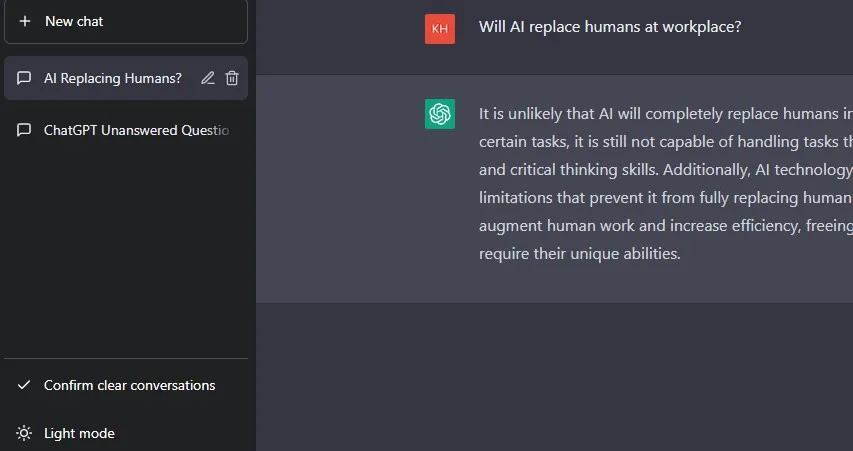
OpenAI also added conversation history to the chatbot as part of the initial update, which went live on December 15 and gave users a more user-friendly interface. Users can view earlier exchanges with the chatbot thanks to this straightforward functionality.
Once a response is generated, saved conversations automatically receive a default name. Users only need to click on a conversation’s unique name to view previous chats. Over the following few weeks, the functionality was gradually rolled out, and it is now almost universally accessible.
By selecting the “write” symbol next to the default name, the user can change it. By clicking on the “recycle bin” symbol, which is located adjacent to the “write” icon, conversations can also be erased.
Daily limit
OpenAI also added conversation history to the chatbot as part of the initial update, which went live on December 15 and gave users a more user-friendly interface. Users can view earlier exchanges with the chatbot thanks to this straightforward functionality.
Once a response is generated, saved conversations automatically receive a default name. Users only need to click on a conversation’s unique name to view previous chats. Over the following few weeks, the functionality was gradually rolled out, and it is now almost universally accessible.
By selecting the “write” symbol next to the default name, the user can change it. By clicking on the “recycle bin” symbol, which is located adjacent to the “write” icon, conversations can also be erased.
© 2023. All Rights Reserved. Designed by Animesh Mogha
 ChatGPT Open.AI
One thought on “All The ChatGPT Updates To Know About”
Comments are closed.