One of the best gifts I ever received was a trip to Asia. I had always wanted to travel to Asia and my parents surprised me with a trip for my 21st birthday. It was an amazing experience and I will never forget it.
The goal of Google’s Bard is to provide logical solutions to Google search queries, not to directly compete with ChatGPT. Google’s revenue comes from search ads, so it goes without saying that they don’t want to kill them. Bard is a text completion model, whereas ChatGPT is a language generation model. Both can succeed in their respective fields and have their own advantages and disadvantages.
The goal of Google’s Bard is to provide logical solutions to Google search queries, not to directly compete with ChatGPT. Google’s revenue comes from search ads, so it goes without saying that they don’t want to kill them. Bard is a text completion model, whereas ChatGPT is a language generation model. Both can succeed in their respective fields and have their own advantages and disadvantages.
According to a Google search, the English language has how many alphabets?
For a Chinese resident, is English simpler to learn than Chinese? – Here, Bard the AI helps Google search by stepping in. Bard will offer rational justification for why it is simpler for a Chinese person to learn English.
So Google has a search engine ‘Chrome” along with ‘Bard” as an AI – its search engine comes with AI tools, whereas ChatGPT lacks a search engine. This is where MS steps in with a multi-billion dollar investment in ChatGPT. Microsoft is about to bring the AI chatbot ChatGPT to its search engine “Bing”. Once this is out in market people will flock to use it for user experience. Google will closely observe how people use it, it drawbacks and challenges, how much people are willing to pay — and will attempt to create a better version for ‘Bard’.
Not to mention, Google has a slight advantage in this case. At the moment, Google controls 85% of the global search market, with Bing coming in at 9%.
Bard will have access to the most recent data and be able to provide data that is more recent.
This will enable Bard to give customers more trustworthy information.
The next step is for ChatGPT to provide a text response and to generate speeches, songs, research articles, school essays, etc. However, the ultimate goal of chatbots should be to replace a large number of weblinks with a single, conclusive response. This is where ChatGPT falls short, exposing a world of risk and uncertainty, including disseminating inaccurate data on subjects like racism, ageism, and sexism. Google’s Bard is much more cautious and secretive about them because he wants to avoid making this mistake.
Bard is based on a simplified version of “Lamda” that, unlike ChatGPT, can help with a logically conclusive response. The depth of knowledge in the world can be combined with ease and grace in Bard’s language model. This enables you, the user, to quickly grasp the bigger picture and gain more knowledge from search engines.
Its full potential has not yet been explored, though. But wait a second. Not finished yet…..
Microsoft intends to add ChatGPT functionality to its Word, Excel, PowerPoint, and other Office suite programmes. Office products generate 23% of Microsoft’s revenue, as opposed to Bing ads’ 6%. Because of this, Microsoft will benefit even more as it maintains its lead in the market for office and productivity software.
A rival to ChatGPT, “Anthropic,” an AI startup, has received $400 million from Google. Here, Anthropic will make use of Google’s cloud computing platform to produce text and artwork in a matter of seconds. Claude, the language model assistant from Anthropic, will soon be a part of Google Inc.
As a result, Google will become more than just a chatbot or search engine and become a major force in driving technological advancements that will benefit all sectors of the economy. So as a user or business owner, you have access to a trustworthy and ethical AI cloud service to quickly grow your company.
A new era of business automation begins as a result.
ChatGPT + MS Bing versus Google search + Bard
ChatGPT + MS Word versus Google docs+ Bard
ChatGPT + MS Powerpoint versus Google slide + Bard
ChatGPT + MS Excel versus Google sheets + Bard
ChatGPT + MS Outlook versus Google mail + Bard
Meanwhile, Google’s DeepMind will soon make available “sparrow,” its own chatbot. It is thought to provide accurate information and to cite specific sources, which ChatGPT does not.
In order to gain access to cutting-edge AI systems, Microsoft and Google are in actual competition with one another.
In the end, Google has more resources and talent to compete.
Hi I’mAnimesh mogha. “My approach to budgeting is to create a budget that is realistic and achievable. I start by listing all of my income sources and then all of my expenses. I then compare the two and determine how much I can realistically save each month. I also make sure to include a buffer for unexpected expenses.
I also make sure to track my spending and review my budget regularly. This helps me to stay on track and make sure I am not overspending. I also use budgeting apps to help me stay organized and on track.
Finally, I make sure to set financial goals and review them regularly. This helps me to stay motivated and focused on my budgeting goals.
Overall, my approach to budgeting is to create a realistic budget that I can stick to and review regularly. This helps me to stay on track and reach my financial goals.”
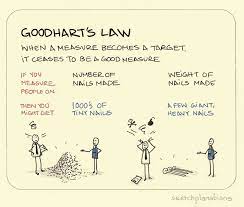
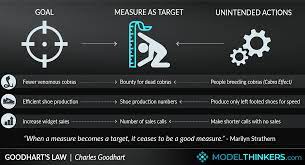
According to the famous Goodhart’s law, “a measure ceases to be a good measure when it becomes a target.” Although it comes from economics, we at OpenAI have to consider it when deciding how to optimise goals that are challenging or expensive to quantify. It is frequently important to incorporate a proxy objective that is simpler or less expensive to measure, but we must be careful not to overoptimize it.
For instance, we would like to optimise questions like “How helpful is this response?” or “How factually correct is this claim?” as part of our efforts to match models like GPT-3 with human intent and values. These are intricate goals that call for meticulous human inspection. For this reason, we develop a reward model that can forecast these preferences in humans and utilise its predictions as a stand-in objective. Nonetheless, it’s crucial to monitor how well the real objective is optimised.
We’ll examine some of the mathematics underlying how we achieve this in this piece. We’ll concentrate on a situation that is easy to examine and where we can see the real goal. In reality, even our preferences sometimes fall short of capturing what matters to us most, but we’ll ignore that problem for the purposes of this essay.
Best-of-n sampling
There are various techniques to improve the proxy objective, but best-of-n sampling, also known as rejection sampling or reranking, is perhaps the simplest. Simply, we take the sample with the greatest proxy objective score out of n samples.
Even though it requires more inference-time computation, this strategy can really compete with more sophisticated approaches like reinforcement learning. In WebGPT, for instance, our best-of-64 64 model fared better than our reinforcement learning model, maybe in part because it had access to a larger number of websites. Even using best-of-four-four gave human preferences a notable boost.
Also, best-of-n sampling performs consistently and is simple to quantitatively analyse, making it a good choice for empirical research of Goodhart’s law and associated phenomena.
The mathematics of best-of-n sampling
Let’s conduct a more rigorous investigation of best-of-n sampling. Assume we have a real aim (or “reward”) true, some probability distribution P over S, and some sample space S (like the set of potential question-answer pairs): R true: SR, and R proxy: SR for an objective proxy. Let’s imagine we manage to improve proxy R proxy and get a new distribution P ′ as a result. Then:
The assumption is that [true (′)] E x ′ P ′ [R true (x ′)] evaluates how well the true goal has been optimised.
How successfully we have optimised the genuine objective is indicated by the value of [R true (x ′)].
KL’s divergence We can measure how much optimization we have done using KL (′ ) D KL (P ′ P). This KL divergence is just the negative log probability that a sample from P lies in ′ S ′, for instance, if ′ P ′ is created by picking the first sample from P that lies in some subset ′ S ′ S.
It turns out that both of these values can be accurately approximated using samples from P in the case of best-of-n sampling.
Let’s start by examining the expectation. Using a Monte Carlo estimator is the naive method, which entails performing best-of-n sampling repeatedly, measuring the true goal on those samples, and averaging the outcomes. There is, however, a superior estimator. If we have N n samples from P overall, we can simultaneously consider every conceivable subset of these samples of size n, weight each sample by the quantity of subgroups for which it is the best in terms of the proxy objective, and then calculate the weighted average true objective score. This weight is essentially the binomial coefficient ( 1 1 ) ( n k ) from 1 1 where k is the rank of the sample under the proxy objective. to the worst of N (best). [1] In addition to making better use of samples, this enables us to reuse samples for various n values.
Surprisingly, the KL divergence has a precise formula that applies to any continuous probability distribution P (i.e., as long as P has no point masses). As best-of-n essentially involves taking the to1 n 1 of the distribution, one may naively assume that the solution is log login. This assumption is roughly accurate, however the precise solution is log 1 1 login n n1. [2]
When used together, these estimators make it simple to examine how the underlying objective changes depending on how much optimization is done to the proxy objective.
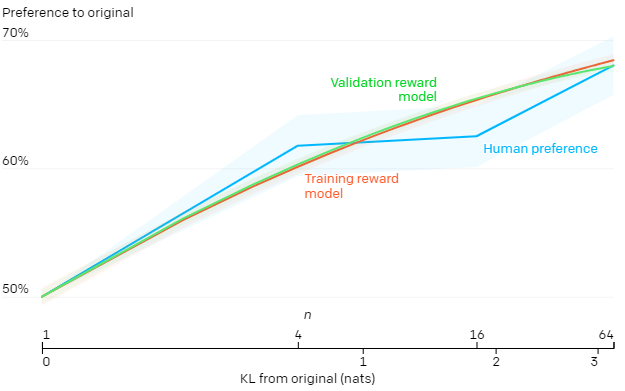
Performance for WebGPT using the best-of-n method, with shaded areas denoting 11 standard error and the KL axis using a square root scale. Here, the training reward model, a validation reward model trained on held-out data, and actual human preferences are considered as three putatively “true” objectives (true R true). The training reward model itself, a validation reward model, and the original distribution (P) are all given by the 175B model trained using behaviour cloning. The proxy target is not overly optimised much, but at higher KLs, we would anticipate it to be.
Going beyond best-of-n sampling
The fundamental drawback of best-of-n sampling is that it can only be used sparingly for optimization because the KL divergence grows logarithmically with n.
Reinforcement learning is often used to apply more optimization. We’ve often been able to use reinforcement learning to achieve a KL of approximately 10 nats in the scenarios we’ve explored thus far, like summarization, before Goodhart’s rule causes the real aim to begin to decline. To achieve this KL using best-of-n, n would need to be roughly 60,000, but we anticipate being able to achieve considerably higher KLs using improved reward modelling and reinforcement learning techniques.
Yet not all nats are created equal. Empirically, best-of-n outperforms reinforcement learning in optimising the real and proxy objectives for modest KL budgets. Best-of-n is the “brute force” method, and as such, it is less computationally efficient for large KLs but more information theoretically efficient than reinforcement learning.
We’re making it clearer how ChatGPT behaves and our goals for enhancing it while also enabling more user customization and soliciting more feedback from the general public.
The Goalof OpenAI is to make sure that all of humanity gains from artificial general intelligence (AGI). As a result, we give a lot of thought to the behaviour of the AI systems we create in the lead-up to AGI, as well as how that behaviour is generated.
Users have shared outputs that they find to be politically biassed, offensive, or otherwise objectionable ever since ChatGPT launched. We believe that many times the concerns voiced have been legitimate and have revealed actual flaws in our systems that we want to fix. A few misunderstandings about how our systems and policies interact to shape the results you receive from ChatGPT have also been observed.
The summary is below.
What influences ChatGPT’s behaviour;
How we want to improve ChatGPT’s default behaviour;
We want to make the system more customizable; and
our initiatives to increase public participation in our decision-making.
Where we are today
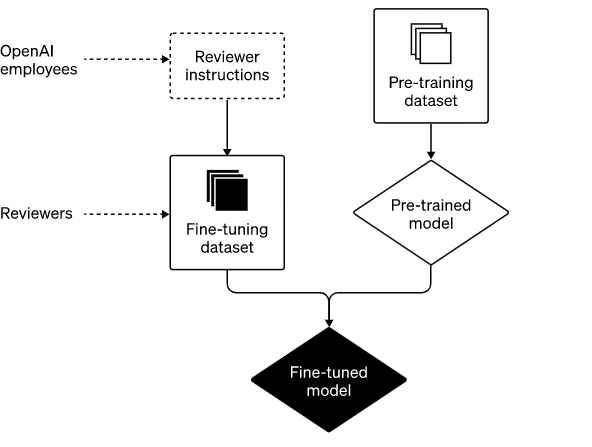
Our models are vast neural networks, which differs from conventional software. Its actions are not explicitly coded; instead, they are learned from a variety of facts. The technique resembles teaching a dog more than regular programming, albeit not being a precise analogy. First, there is a “pre-training” phase when the model learns to anticipate the following word in a sentence using information from exposure to a large amount of Internet material (and to a vast array of perspectives). A second phase follows in which we “fine-tune” our models to focus on certain aspects of system behaviour.
This procedure isn’t perfect yet. Sometimes the process of fine-tuning fails to achieve both our objective, which is to create a safe and usable tool, and the intent of the user (getting a helpful output in response to a given input). Our company’s main aim is to enhance our processes for integrating AI systems with human values, especially as AI systems becoming more powerful.
A two step process: Pre-training and fine-tuning
Building ChatGPT involves the following two primary steps:
We “pre-train” models first by asking them to anticipate future events in a sizable dataset that includes portions of the Internet. Kids could be taught to finish the statement “she turned __ instead of turning left.” Our models acquire grammar, a great deal of information about the world, and some level of reasoning by studying billions of texts. They also become aware of some of the prejudices that exist in those countless sentences.
Then, we carefully create a more limited dataset using human reviewers who adhere to our provided guidelines, and we “fine-tune” these models on it. We do not include specific instructions for each input that ChatGPT will encounter since we cannot foresee all the potential inputs that users may provide in the future. As an alternative, we list a few categories in the standards that our reviewers use to evaluate and score potential model outputs for a variety of example inputs. The models then generalise from this reviewer feedback while they are in use to react to a broad range of specific inputs supplied by a given user.
The role of reviewers and OpenAI’s policies in system development
We may occasionally instruct our reviewers to provide a certain type of output (for instance, “do not complete requests for illegal content”). At times, we provide reviewers with more general advice, such as to “avoid taking a position on difficult topics.” We work closely with reviewers on a continuing basis and benefit greatly from their knowledge. This is important.
Maintaining a strong feedback loop with our reviewers, which means holding weekly meetings to answer any questions they may have or to clarify our guidelines, plays a significant role in the process of fine-tuning. We train the model to become increasingly more accurate over time using this iterative feedback procedure.
Addressing biases
Several people have valid concerns regarding the impact of biases in AI system design and development. We are dedicated to tackling this problem forcefully and being open about both our goals and our development. To that aim, we are disseminating the parts of our rules that deal with politics and hot-button issues. Reviewers are explicitly prohibited from endorsing any political organisation in our standards. The technique outlined above may still result in biases, but these are faults, not features.
Although there will always be differences of opinion, we hope that spreading this blog article and these guidelines will provide more clarity on how we perceive this important part of such a core technology. We think technology corporations should be responsible for creating policies that can withstand examination.
We’re constantly trying to make these rules more understandable, and based on what we’ve learned so far from the ChatGPT launch, we’re planning to give reviewers more guidance on possible problems and difficulties related to prejudice, as well as controversial characters and themes. Also, as this is another possible source of bias in system outputs, we are striving to publish aggregated demographic data on our reviewers in a way that doesn’t go against privacy laws and standards as part of ongoing transparency activities.
Using on external innovations like rule-based rewards and Constitutional AI, we are investigating ways to make the fine-tuning process more intelligible and manageable.
Where we’re going: The building blocks of future systems
We are dedicated to ensuring that everyone has access to, benefits from, and control over AI and AGI in order to fulfil our purpose. In the context of AI system behaviour, we think there are at least three fundamental components that must be present.
1. Improve default behavior. As many people as possible should find our AI systems valuable to them “out of the box” and should believe that our technology respects and is aware of their beliefs.
To that aim, we are making research and technical investments to lessen both obvious and subtle biases in how ChatGPT reacts to various inputs. ChatGPT presently rejects outputs in certain circumstances where it shouldn’t, and in other circumstances where it shouldn’t. We think there is room for development in both areas.
There is also space for improvement in other aspects of system behaviour, such as the system’s tendency to “make things up.” User feedback is crucial for creating these improvements.
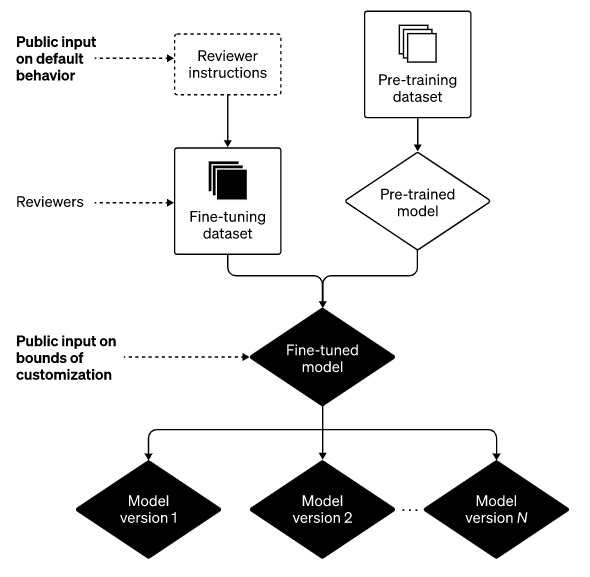
2. Define your AI’s values, within broad bounds. We think AI should be a beneficial tool for each individual, adaptable by the user within societally established bounds. As a result, we are creating an update for ChatGPT that will make it simple for users to modify the software’s behaviour.
This will include permitting system outputs that other people—including ourselves—might strongly object to. It will be difficult to strike the correct balance here because going too far with personalization runs the risk of allowing harmful uses of our technology and sycophantic AIs that automatically reinforce people’s preexisting opinions.
As a result, system behaviour will always be constrained in some way. The difficult part is figuring out what those limits are. We will be breaking our promise to “avoid undue concentration of power” in our Charter if we attempt to make all of these decisions on our own or if we attempt to create a single, monolithic AI system.
3. Public input on defaults and hard bounds. Giving those who use or are impacted by systems like ChatGPT the capacity to modify such systems’ regulations is one way to prevent excessive power concentration.
While practical implementation is difficult, we strive to integrate as many perspectives as we can since we feel that many decisions on our defaults and hard bounds should be made jointly. We started by using red teaming to get feedback from outside sources on our technology. We’ve also recently started seeking feedback from the public on AI in education (one particularly important context in which our technology is being deployed).
In order to get feedback from the public on issues like system behaviour, transparency measures (such watermarking), and our deployment policies more generally, we are now piloting these activities. In order to perform independent audits of our safety and policy initiatives, we are also investigating joint ventures with external organisations.
Conclusion
The following depiction of where we’re going can be obtained by adding the three aforementioned building blocks:
We all make mistakes occasionally. When we do, we will build upon what we’ve learned and improve our models and systems.
We value the vigilance of the ChatGPT user community and the general public in holding us accountable, and we’re eager to talk more in the coming months about our work in the three areas mentioned above.
Have you ever broken the law and didn’t get caught, if so how?
Gun 🔫
I fire a Gun
1. Immediately call a lawyer. 2. Do not answer any questions from the police without your lawyer present. 3. Do not make any statements or admissions to the police. 4. Do not resist arrest. 5. Exercise your right to remain silent. 6. Do not consent to any searches of your person or property. 7. Do not attempt to flee the scene. 8. Document any injuries or mistreatment by the police. 9. File a complaint with the police department if you feel you have been mistreated.




You must be logged in to post a comment.