Today, we are thrilled to announce that ChatGPT is available in preview in Azure OpenAI Service. With Azure OpenAI Service, over 1,000 customers are applying the most advanced AI models—including Dall-E 2, GPT-3.5, Codex, and other large language models backed by the unique supercomputing and enterprise capabilities of Azure—to innovate in new ways.
Since ChatGPT was introduced late last year, we’ve seen a variety of scenarios it can be used for, such as summarizing content, generating suggested email copy, and even helping with software programming questions. Now with ChatGPT in preview in Azure OpenAI Service, developers can integrate custom AI-powered experiences directly into their own applications, including enhancing existing bots to handle unexpected questions, recapping call center conversations to enable faster customer support resolutions, creating new ad copy with personalized offers, automating claims processing, and more. Cognitive services can be combined with Azure OpenAI to create compelling use cases for enterprises. For example, see how Azure OpenAI and Azure Cognitive Search can be combined to use conversational language for knowledge base retrieval on enterprise data.
Customers can begin using ChatGPT today. It is priced at $0.002/1k tokens and billing for all ChatGPT usage begins March 13th.
Real business value
Customers across industries are seeing business value from using Azure OpenAI Service, and we’re excited to see how organizations such as The ODP Corporation, Singapore’s Smart Nation Digital Government Office, and Icertis will continue to harness the power of Azure OpenAI and the ChatGPT model to achieve more:
“The ODP Corporation is excited to leverage the powerful AI technology of ChatGPT from Azure OpenAI Service, made possible through our collaboration with Microsoft. This technology will help [The ODP Corporation] drive continued transformation in our business, more effectively explore new possibilities, and design innovative solutions to deliver even greater value to our customers, partners, and associates. [The ODP Corporation] is building a ChatGPT-powered chatbot to support our internal business units, specifically HR. The chatbot has been successful in improving HR’s document review process, generating new job descriptions, and enhancing associate communication. By utilizing ChatGPT’s natural language processing and machine learning capabilities, [The ODP Corporation] aims to streamline its internal operations and drive business success. Embracing this cutting-edge technology will help increase our competitive edge in the market and enhance our customer experience.”—Carl Brisco, Vice President Product and Technology, The ODP Corporation
“Singapore’s Smart Nation Digital Government Office is constantly looking to empower our public officers with technology to deliver better services to Singaporeans and better ideas for Singapore. ChatGPT and large language models more generally, hold the promise of accelerating many kinds of knowledge work in the public sector, and the alignment techniques embedded in ChatGPT help officers interact with these powerful models in more natural and intuitive ways. Azure OpenAI Service’s enterprise controls have been key to enabling exploration of these technologies across policy, operations, and communication use cases.”—Feng-ji Sim, Deputy Secretary, Smart Nation Digital Government Office, under the Prime Minister’s Office, Singapore
“Contracts are the foundation of commerce, governing every dollar in and out of an enterprise. At Icertis, we are applying AI to contracts so businesses globally can drive revenue, reduce costs, ensure compliance, and mitigate risk. The availability of ChatGPT on Microsoft’s Azure OpenAI service offers a powerful tool to enable these outcomes when leveraged with our data lake of more than two billion metadata and transactional elements—one of the largest curated repositories of contract data in the world. Generative AI will help businesses fully realize the intent of their commercial agreements by acting as an intelligent assistant that surfaces and unlocks insights throughout the contract lifecycle. Delivering this capability at an enterprise scale, backed by inherent strengths in the security and reliability of Azure, aligns with our tenets of ethical AI and creates incredible new opportunities for innovation with the Icertis contract intelligence platform.”—Monish Darda, Chief Technology Officer at Icertis
In addition to all the ways organizations—large and small—are using Azure OpenAI Service to achieve business value, we’ve also been working internally at Microsoft to blend the power of large language models from OpenAI and the AI-optimized infrastructure of Azure to introduce new experiences across our consumer and enterprise products. For example:
GitHub Copilot leverages AI models in Azure OpenAI Service to help developers accelerate code development with its AI pair programmer. • Microsoft Teams Premium includes intelligent recap and AI-generated chapters to help individuals, teams, and organizations be more productive. • Microsoft Viva Sales’ new AI-powered seller experience offers suggested email content and data-driven insights to help sales teams focus on strategic selling motions to customers. • Microsoft Bing introduced an AI-powered chat option to enhance consumers’ search experience in completely new ways.
These are just a few examples of how Microsoft is helping organizations leverage generative AI models to drive AI transformation.
Customers and partners can also create new intelligent apps and solutions to stand out from the competition using a no-code approach in Azure OpenAI Studio. Azure OpenAI Studio, in addition to offering customizability for every model offered through the service, also offers a unique interface to customize ChatGPT and configure response behavior that aligns with your organization.
Watch how you can customize ChatGPT using System message right within Azure OpenAI Studio.
A responsible approach to AI
We’re already seeing the impact AI can have on people and companies, helping improve productivity, amplify creativity, and augment everyday tasks. We’re committed to making sure AI systems are developed responsibly, that they work as intended, and are used in ways that people can trust. Generative models, such as ChatGPT or DALL-E image generation model, are models that generate new artifacts. These types of models create new challenges; for instance, they could be used to create convincing but incorrect text to creating realistic images that never happened.
Microsoft employs a layered set of mitigations at four levels, designed to address these challenges. These are aligned with Microsoft’s Responsible AI Standard. First, application-level protections that put the customer in charge, for instance, explaining that text output was generated by AI and making the user approve it. Second, technical protections like input and output content filtering. Third, process and policy protections that range from systems to report abuse to service level agreements. And fourth, documentation such as design guidelines and transparency notes to explain the benefits of a model and what we have tested.
We believe AI will profoundly change how we work, and how organizations operate in the coming months. To meet this moment, we will continue to take a principled approach to ensure our AI systems are used responsibly while listening, learning, and improving to help guide AI in a way that ultimately benefits humanity.
Getting started with Azure OpenAI Service
1. Learn more about Azure OpenAI Service and more about all the latest enhancements.
2. Get started with ChatGPT using Azure OpenAI Service.
3. Get started with the “Introduction to Azure OpenAI Service” course on Microsoft Learn.
4. Read the Partner announcement blog, Empowering partners to develop AI-powered apps and experiences with ChatGPT in Azure OpenAI Service
Seth Juarez, Principal Program Manager and co-host of The AI Show, shares top use cases for Azure OpenAI Service and an example chatbot for retail using ChatGPT.
Everyone is currently talking about ChatGPT. The chatbot powered by artificial intelligence (AI), developed by OpenAI, has surpassed 100 million users in just two months, making it the fastest-growing consumer application in history. In order to make ChatGPT more precise in its responses more factually resilient, OpenAI has been working releasing novel improvements as the number of users keeps growing.
It is very amazing how widely popular the chatbot has become. The AI-powered chatbot received 13 million unique visitors daily in January, according to a UBS study. One of the most well-known social media platforms in the world, TikTok, took about nine months from its release to reach the 100 million monthly active user threshold. Instagram, which is owned by Meta, usually always posts new content new updates and features, took two-and-half years to reach the number.
Let’s try to understand what it is about this chatbot that sets it apart from the competition and challenges the authority and supremacy of search engine giant Google before we look at the updates.
Why is ChatGPT famous?
People are using this tool because of its clear benefits: it is an AI that can produce responses that are almost human-like to any questions the user may have. Frequently, the response is well-organized and packed with specific information.
ChatGPT, which is based on Generative Pre-trained Transformer (GPT), is essentially a neural network learning model that may be used to train a machine to carry out tasks related to natural language processing (NLP).
Simply defined, the neural network is essentially a learning algorithm that allows the chatbots resemble the brain and understand human languages as they are spoken or typed, while the GPT enables this new chatbot to react in a conversational manner.
Yet, despite all the hullabaloo, this tool is still a work in progress.
Several have noticed issues with its responses, particularly in terms of factual accuracy given that the information is only up to 2021. This means that inquiries like “who won the FIFA World Cup 2022?” and similar ones that would be related to events after it cannot be accurately answered by the chatbot.
Concerns have also been raised about how it could be misused to produce malware or phishing emails, two of the most significant negative aspects of AI chatbots that researchers have been able to identify.
Updates are therefore even more crucial before it develops into the de facto digital assistant or search engine.
All the important ChatGPT updates ChatGPT Plus
OpenAI published a blog post on February 1 announcing the debut of ChatGPT Plus. The ChatGPT pilot membership package, which costs USD 20 per month, will grant customers access to the platform even during periods of peak usage, as well as quicker response times and priority access to new features and enhancements.
In the first phase, the premium service was made available to users in the US. “People from our waitlist” will begin receiving invites, according to OpenAI, during the next few weeks. Also, the service will be expanded to new nations and areas.
Contrary to “ChatGPT Pro,” which will be a much improved and upgraded version of the current chatbot, ChatGPT Plus is not the same thing.
Improved factuality and maths capabilities
On January 30, 2023, OpenAI updated the ChatGPT model with increased factuality and mathematical ability in response to criticism that it provided incorrect answers to arithmetic questions.
Experts have already discovered that this chatbot prototype has not always been accurate when it comes to mathematics, despite the fact that it is unclear exactly how the upgrade is altering the responses by ChatGPT.
As a result, the timely upgrade essentially means that the AI chatbot will be able to provide more accurate answers to questions involving computations. This makes ChatGPT even more beneficial for academics and working people in sectors like data science and statistical analysis, among others where crunching numbers is a crucial duty.
Deedy Das, the original engineer at Glean, discovered that despite the upgrade, ChatGPT failed to provide accurate answers to simple mathematical questions
In contrast, the AI chatbot “crushed the math with calculator section of a 2020 SAT and only made two mistakes,” according to Rizz co-founder and CEO Charis Zhang.
In response to a user’s comment about ChatGPT making more mistakes, Zhang stated that the chatbot “suspiciously” provided the correct response without providing an explanation for many practise issues.
I wonder whether it was designed for some test banks to know the choices but not the rationale behind the correct ones. penned Zhang.
A difficult mathematical problem may be beyond the capabilities of ChatGPT, in addition to simple mathematical problems.
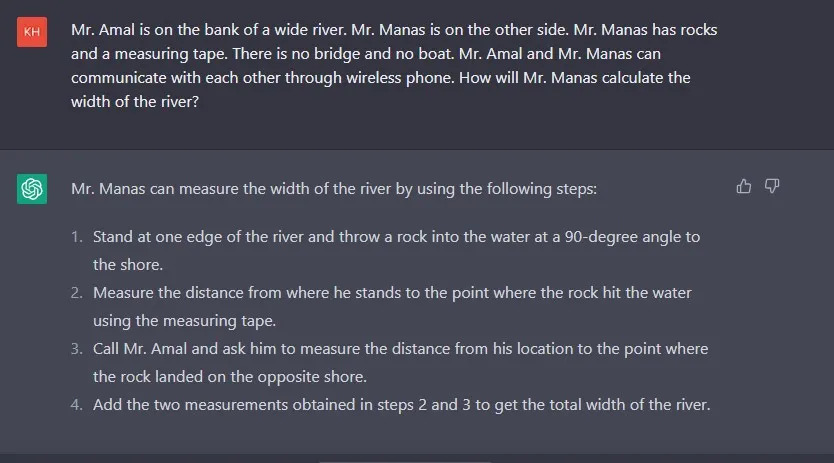
The user questioned the chatbot about a trigonometry problem in the example below. The answer provided by ChatGPT appears to be incomputable. In fact, it is not even necessary to “throw a rock” in order to determine the river’s breadth.
Stop generating
The lengthy replies were rather frustrating, even though Open AI quickly gained notoriety for its prompt and human-like responses. A capability to suspend text generation was added to the chatbot to address this issue.
According to customer feedback, OpenAI introduced the option to discontinue generating ChatGPT’s answer on January 9 in its release notes. Together with this update, it also underwent various revisions to enhance factuality and correctness.
When should I “stop generating”?
Typically, ChatGPT can occasionally keep responding to a query with sentence after sentence. The user might not have needed any additional information on the subject because they may have found their answer in the first few phrases. Anything that ChatGPT might possibly be producing in this instance
This is when ‘Stop Producing’ comes in handy. It is a button that is located at the bottom of the screen, in the centre. The AI chatbot is informed that it might cease responding to queries by clicking on it.
The AI chatbot quickly stops developing its response when the button is clicked, according to user experience. Then, the button changes into a “Regenerate response” button. When you click it, ChatGPT starts responding from scratch but in a different way. When the previously generated answer did not satisfy the user, this is helpful.
A command must be entered in the command box if the user wants ChatGPT to keep giving the same response even after being requested to stop generating it. It could be “continue” or “start where you stopped” or any other similar word or sentence which would mean the same.
Performance update
After a fortnight following the AI chatbot’s public debut, on December 15, 2022, the first round of ChatGPT updates was made available.
One of the features was an improvement to the general performance. Users will note that ChatGPT is now less likely to refuse to answer inquiries, according to a statement made at the time by OpenAI, among other enhancements.
The performance improvement, presumably, may have been made after OpenAI CEO Sam Altman tweeted on December 4 that “retraining” was planned for the chatbot to improve it.
Conversation history
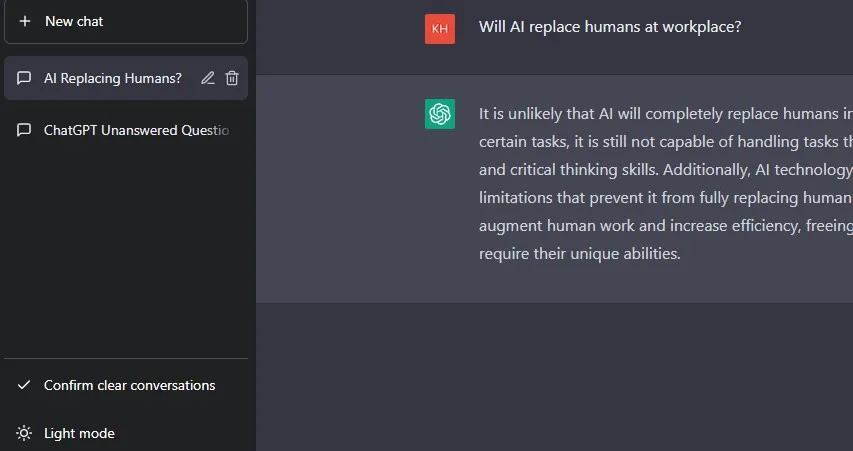
OpenAI also added conversation history to the chatbot as part of the initial update, which went live on December 15 and gave users a more user-friendly interface. Users can view earlier exchanges with the chatbot thanks to this straightforward functionality.
Once a response is generated, saved conversations automatically receive a default name. Users only need to click on a conversation’s unique name to view previous chats. Over the following few weeks, the functionality was gradually rolled out, and it is now almost universally accessible.
By selecting the “write” symbol next to the default name, the user can change it. By clicking on the “recycle bin” symbol, which is located adjacent to the “write” icon, conversations can also be erased.
Daily limit
OpenAI also added conversation history to the chatbot as part of the initial update, which went live on December 15 and gave users a more user-friendly interface. Users can view earlier exchanges with the chatbot thanks to this straightforward functionality.
Once a response is generated, saved conversations automatically receive a default name. Users only need to click on a conversation’s unique name to view previous chats. Over the following few weeks, the functionality was gradually rolled out, and it is now almost universally accessible.
By selecting the “write” symbol next to the default name, the user can change it. By clicking on the “recycle bin” symbol, which is located adjacent to the “write” icon, conversations can also be erased.
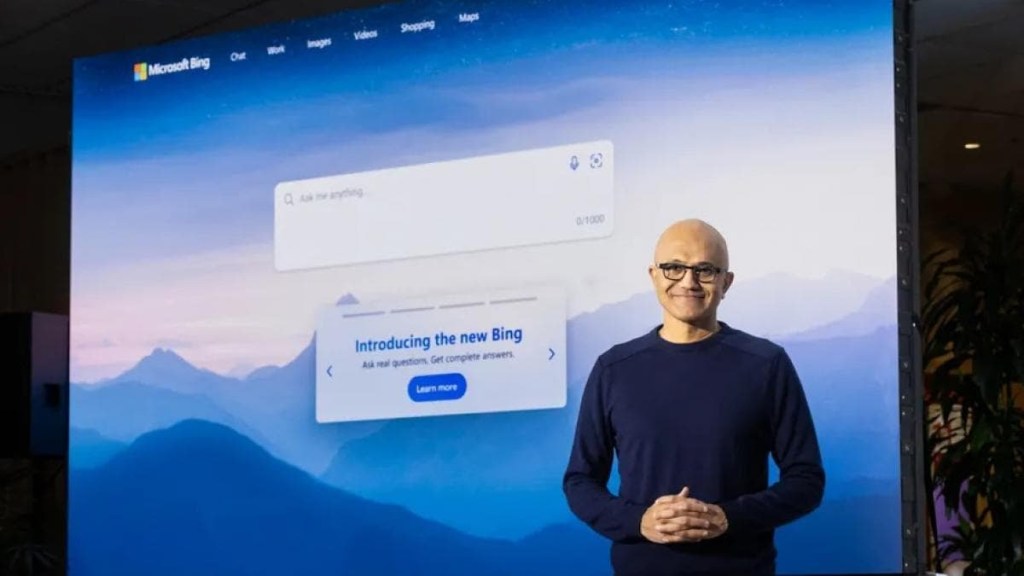
Microsoft’s search engine, Bing, has exceeded 100 million daily active users only a month after the launch of its chatbot AI. Yusuf Mehdi, Microsoft’s Vice President for Modern Life, Search and Devices, acknowledged that Bing remains a small player in the search engine market but highlighted the progress it has made since Bing AI chatbot was first introduced. The release of Bing’s next-gen version has led to an increase in new users, with one-third of its daily active users being new to the platform.
“We see this appeal of the new Bing as a validation of our view that search is due for a reinvention and of the unique value proposition of combining Search + Answers + Chat + Creation in one experience,” Mehdi said.
Microsoft has also reported an increase in engagement, with more people conducting searches on Bing. The company credits this success to the growth of Edge usage and the introduction of the Prometheus AI model, which has led to more relevant search results.
The company has seen a significant increase in the use of Bing’s chat AI, with one-third of its daily preview users using the feature for their queries. On average, Microsoft is seeing three chats per session, with over 45 million chats since the new Bing was introduced.
Microsoft bringing the fight to Google
Microsoft’s integration of an AI chatbot into Bing has given the search engine a competitive edge against Google. The introduction of Bing’s AI chatbot on mobile has been particularly successful, leading to a six-time increase in daily active users.
However, Google has also announced plans to launch its own chatbot, Bard, and introduced it last month. While Bard’s unofficial debut was marred by misinformation, Google is working to improve its chatbot’s responses before it becomes available.
The addition of Bing’s chatbot AI has made the search engine more appealing to users, especially those who prefer a conversational approach to searching. Microsoft’s efforts to improve the relevance of search results and the user experience have also contributed to Bing’s growing popularity. While Bing still has a long way to go to catch up to Google’s search algorithm, the recent surge in daily active users is a promising sign for Microsoft’s search engine.
Years before ChatGPT, two google engineers developed an advanced AI chatbot.
Google is expected to release its widely anticipated AI chatbot Bard in the near future. But years ago, two ex-Google engineers pushed their former employer to release a similar chatbot to the public — and they were met with resistance, according to a new report from The Wall Street Journal.
Around 2018, Daniel De Freitas, who was a research engineer at Google, started working on an AI side project with the goal of creating a conversational chatbot that mimicked the ways humans speak, former colleagues told the Journal. Noam Shazeer, a software engineer for Google’s AI research unit, later joined the project.
Per the Journal, De Freitas and Shazeer were able to build a chatbot, which they called Meena, that could argue about philosophy, speak casually about TV shows, and generate puns about horses and cows. They believed that Meena could radically change the way people search online, their former colleagues told the Journal. But their efforts to launch the bot — which they renamed LaMDA, which would become the language model behind Bard — reached an impasse after Google executives said the chatbot didn’t adhere to its AI safety and fairness standards, per the Journal. Executives thwarted multiple attempts made by the engineers to send the bot to external researchers, add the chat feature to Google Assistant, and launch a demo to the public, the Journal reported.
Frustrated by the executive response, De Freitas and Shazeer left Google near the end of 2021 to start their own company — despite CEO Sundar Pichai personally requesting they stay and continue working on the chatbot, per the Journal. Their company, which now goes by Character.Ai, has since released a chatbot that can roleplay as figures like Elon Musk or Nintendo’s Mario. “It caused a bit of a stir inside of Google,” Shazeer said in an interview with investors Aarthi Ramamurthy and Sriram Krishnan last month. “But eventually we decided we’d probably have more luck launching stuff as a startup.”
De Freitas and Shazeer declined an interview request from the Journal, and did not respond to Insider’s request for comment. Google did not respond to Insider’s request for comment.
Google has been thwarting its AI efforts since 2012
Google’s hesitancy to release its AI tools is nothing new.
In 2012, Google hired Ray Kurzweil, a computer scientist, to work on its language processing models, TechCrunch reported. About one year later, Google bought British AI firm DeepMind which aimed to create artificial general intelligence, per TechCrunch.
However, academics and tech experts pushed back on using the tech due to ethical concerns around mass surveillance, the Journal reported, and Google committed to limiting how it would use AI. In 2018, Google ended its project to use its AI tech in military weapons in response to employee backlash, per the Journal. But Google’s AI plans may now finally see the light of day, even as discussions around whether its chatbot can be responsibly launched continue. The company’s chatbot, Bard, will come after Microsoft — whose stock is on the rise — released its own chatbot through Bing.
After Google’s Bard chatbot generated a factual error during its first public demo last month, Google employees were quick to call the announcement “rushed” and “botched.” The chairman of Alphabet, John Hennessy, agreed that Google’s chatbot wasn’t “really ready for a product yet.”
Pichai has asked all Google employees to spend two to four hours of their time helping test the product so it can be ready for launch.
“I know this moment is uncomfortably exciting, and that’s to be expected: the underlying technology is evolving rapidly with so much potential,” Pichai wrote to Google employees in a February memo.
“The most important thing we can do right now is to focus on building a great product and developing it responsibly,” he said.
ChatGPT is what everyone is talking about right now. The artificial intelligence (AI) powered chatbot, created by OpenAI, has become the fastest-growing consumer application in history, crossing 100 million users in just two months. As the number of users continues to rise, OpenAI has been busy with introducing unique updates to make ChatGPT more accurate in its responses and factually robust.
The massive popularity of the chatbot has been indeed astonishing. According to a UBS study, the AI-powered chatbot clocked 13 million unique visitors per day in January. TikTok, one of the world’s most famous social media apps, took around nine months from its launch to hit the 100 million mark in monthly active users. Meta-owned Instagram, which is almost every month coming up with new updates and features, took two-and-half years to reach the number.
Before we check out the updates, let’s try to know what it is about this chatbot that makes it stand above the rest and challenge the authority and dominance of search engine behemoth Google.
Why is ChatGPT famous?
Users are turning to this tool for its obvious utility: it is an AI that can generate human-like responses to almost any question the user may have. The answer is often well-structured and loaded with precise details.
Built on Generative Pre-trained Transformer (GPT), ChatGPT is essentially a neural network learning model through which a machine can be trained to perform tasks that fall within the purview of natural language processing (NLP).
To put it simply, the GPT enables this new chatbot to respond in a conversational way, and the neural network is essentially a learning algorithm which makes the chatbots mimic the brain and understand human languages as they are spoken or typed.
Yet, despite all the hype surrounding it, this tool is still a work in progress.
Many have found problems with its answers, especially with regard to factual accuracy, since the information in it is limited to 2021. This means that the chatbot cannot give accurate answers to queries that would be connected to events after it, such as ‘who won the FIFA World Cup 2022?’ and similar questions.
Also, there are concerns over the manner in which it can be abused into giving answers it is programmed not to, such as generating ransomware or phishing emails — two of the biggest dark sides of the AI chatbot that researchers have been able to point at.
And, that’s why updates become all the more important before it grows into the go-to search engine or digital assistant.
All the important ChatGPT updates ChatGPT Plus
On 1 February, OpenAI announced the launch of ChatGPT Plus in a blog post. At USD 20 per month, the pilot subscription plan for ChatGPT will give users access to the platform even during peak times, besides faster response times and priority access to new features and improvements.
The premium service was rolled out for customers in the US in the first phase. OpenAI said, “people from our waitlist” will start receiving invites over the coming weeks. The service will also be extended to more countries and regions.
ChatGPT Plus is different from ‘ChatGPT Pro,’ which will be a much advanced and improved version of the current chatbot.
Improved factuality and maths capabilities
After coming under fire for giving inaccurate results for arithmetic problems, OpenAI, on 30 January 2023, upgraded the ChatGPT model with improved factuality and mathematical capabilities.
Although there is no clarity on exactly how the upgrade is affecting the responses by ChatGPT, experts have previously found that this chatbot prototype has not always been precise when it comes to mathematics.
Thus the timely upgrade essentially means that the AI chatbot should be able to deliver more accurate results when it comes to queries that involve calculations. This makes ChatGPT even more useful for students and professionals in domains of data science and statistical research, among other related fields where number-crunching is an essential task.
However, one user, Deedy Das, founding engineer at Glean, found that despite the upgrade, ChatGPT failed to provide accurate answers to simple mathematical questions
Conversely, Rizz co-founder and CEO Charis Zhang found that the AI chatbot “crushed the math with calculator section of a 2020 SAT and only made two mistakes.”
Responding to a user’s feedback on more errors being committed by ChatGPT, Zhang said that the chatbot “suspiciously” gave the right answer without explanation on many practice problems.
“I wonder if it has been optimized for certain test banks to know the choices but not why the choice was correct?” wrote Zhang.
Apart from straightforward mathematical equations, it is also possible that ChatGPT is unable to properly answer a complex mathematical problem.
Below is an example where the user asked the chatbot about a trigonometric problem. The answer by ChatGPT is apparently impossible to compute. In fact, the width of the river can be measured without having to “throw a rock” at all.
Stop generating
Though Open AI became instantly famous for its quick and human-like answers, there was one thing which was quite annoying — the lengthy replies. To fix this, the chatbot was given a feature to stop generating text.
“Based on your feedback, we’ve added the ability to stop generating ChatGPT’s response,” OpenAI said in its release notes on 9 January. Along with this update, it also made some changes to improve accuracy and factuality.
What is “stop generating”?
Normally, ChatGPT can sometimes keep returning sentence after sentence in response to a query. It is possible that the user may have had their answer in the first few sentences, and would not require any more information on the subject. In this case, everything that ChatGPT could be generating becomes useless.
‘Stop Generating’ is handy at this point. It is a button placed in the middle of the screen at the bottom. Clicking on it informs the AI chatbot that it can stop answering a query.
User experience reveals that the AI chatbot immediately stops generating its response when the button is clicked. The button then transforms into a ‘Regenerate response’ button. Clicking on it makes ChatGPT begin answering from the very beginning but in a different manner. This is useful when the answer previously generated was not to the user’s satisfaction.
In case the user intends ChatGPT to continue with its original answer after it was asked to stop generating, a command to do so is required to be fed in the command box. It could be “continue” or “start where you stopped” or any other similar word or sentence which would mean the same.
Performance update
The first batch of updates to ChatGPT was released on 15 December 2022, within a fortnight of the public launch of the AI chatbot.
A general performance update was one of the features. At the time, OpenAI said that, among other improvements, “users will notice that ChatGPT is now less likely to refuse to answer questions.”
The performance improvement, presumably, might have been carried out after OpenAI CEO Sam Altman. on 4 December, posted a tweet stating that “retraining” was on the cards to improve the chatbot.
Conversation history
As part of the first update (on 15 December), OpenAI also made conversation history available on the chatbot, thereby giving users a more accessible interface. It’s a simple feature which lets users see past conversations with the chatbot.
Saved conversations automatically get a default name once a response is generated. To view past conversations, users can simply click on the specific name of the conversation and see it. The feature began gradually rolling over the next few weeks and is now almost widely available.
The name can be changed by the user by clicking on the ‘write’ icon next to the default name. Conversations can also be deleted by clicking on the ‘recycle bin’ icon, which is next to the ‘write’ icon.
Daily limit
The daily limit cap was also introduced in the first update.
“To ensure a high-quality experience for all ChatGPT users, we are experimenting with a daily message cap,” said OpenAI in its release.
“If you’re included in this group, you’ll be presented with an option to extend your access by providing feedback to ChatGPT,” the company further said.
The daily limit on the free version is apparently still in place. However, according to a waitlist link posted by the company on messaging platform Discord, the professional ChatGPT (or ChatGPT Pro) will let users get “as many messages as you need (at least 2x the regular daily limit).”
Chat GPT Vs Bard AI Vs Co-pilot Vs BERT – Comparison & Future and many other aspects are discussed here. Artificial intelligence refers to the system’s capability to produce human-like capabilities and mimic human brain capabilities like reasoning, creativity, planning, and learning. Thereby it refers to a technology that has incorporated human intelligence in a machine and enabled various human actions to function.
Chat GPT Vs Bard AI Vs Co-pilot Vs BERT
Highlights
Artificial intelligence and its uses
Uses of Artificial intelligence
What is ChatGPT?
Limitations of ChatGPT
What is BARD?
Limitations of Bard
What is Co-pilot?
Limitations of Co-Pilot
What is BERT?
Limitations of BERT
Future and Way forward
For Bard:
For ChatGPT
For Co-pilot
For BERT
Conclusion
Artificial intelligence and its uses
The main goal of AI is to reduce human efforts, enhance computer learning and assist in data handling for multiple businesses. AI systems can understand the needs of their environment and can function accordingly. The Ai system can process information made available to them by the user or gathered through a camera or other sensors. AI systems can also analyze their actions’ outcomes and modify them based on the analysis.
The ability of artificial intelligence to reason and execute activities that have the best likelihood of reaching a particular goal is its ideal quality. Machine learning (ML), which refers to the idea that computer systems can automatically learn from and adapt to new data without being helped by humans, is a subset of artificial intelligence.
The AI market is rapidly increasing, and technology is becoming a part of our daily lives. In a report by Statista, it was estimated that by 2025 the AI market would reach the $126 billion mark.
Uses of Artificial intelligence
It is being used for personalized shopping by recommending the customers various products based on previous purchases. In addition, AI-powered chatbots in online shopping websites help to create a more customer-friendly environment.
Educators can use AI technology to create smart content and graphical representations of the topics they intend to explain. Top AI technologies are currently being used by students for personalized learning and by analyzing their growth from the virtual platform.
Various automobile companies are using AI machine learnings to make the vehicles detect any objects in their near places and thus help them avoid accidents.
AI filters are nowadays helping to segregate spam emails. AI technology helps to avoid the notification of spam emails, and currently, G-mail helps in the segregation of these emails by up to 99.9% of cases. Also, Apple is incorporating this segregation characteristic of AI in their iPhones to segregate and avoid unwanted notifications.
Navigation and Robotics are other significant applications of AI technology. For example, the GPS is powered by AI technology. This technology uses a combination of Convolutional Neural Networks and Graph Neural Networks, thereby making detecting a location easier. At the same time, AI-powered robotics are used to create a humanized model of robots that can perform various tasks like serving food, cleaning, inventory management, and supplying goods to designated places.
What is ChatGPT?
In November 2022, OpenAI released ChatGPT (Chat Generative Pre-trained Transformer), a chatbot. Due to its capacity to quickly and thoroughly respond to various questions, ChatGPT quickly attracted the public’s attention. For example, through its official website, it can be observed that ChatGPt can write and debug computer programmes, compose music, poems, song lyrics, plots for plays, tales, answer test questions, play games, and simulate an ATM or a chat room. The fundamental role of ChatGPT was to deliver responses to queries by impersonating a human conversationalist.
Also, ChatGPT remembers the responses it has given in the past during talks, leading some users to believe that this technology can also be utilized as customized messaging. Also, it was thought by certain analysts that the ability of ChatGPT to remember its responses could be used to function as a personalized therapist.
Moreover, it costs nothing to use GPT chat. Therefore, OpenAI has released a premium version of Chat GPT in the US. ChatGPT Plus is the name of the premium edition of chat GPT. The paid edition of Chat GPT is available to users for USD 20 per month.
In contrast, those who don’t want to pay can utilize the app’s free version. By providing you with a list of websites pertinent to your queries, Google search assists you in finding suggested answers to your queries. Contrarily, ChatGPT provides you with direct responses that flow naturally. That is comparable to using a manual.
Limitations of ChatGPT
With the launch of ChatGPT, numerous comparisons between ChatGPT and Google searches have been made. Nonetheless, when using ChatGPT to gain answers, one should always conduct a thorough study. When you receive a response via ChatGPT, it is just raw text without any references to reputable sources, citations, or links. Therefore, before utilizing it, it is essential to double-check the responses.
However, its main flaw was noted to be its uneven factual accuracy. It was observed and acknowledged by OpenAI that GPT “sometimes provides plausible-sounding but incorrect or nonsensical answers”. Also, it was observed that GPT had little knowledge about the events that occurred after 2021.
It was also claimed that while training ChatGPT, human reviewers focused on long answers and completely ignored the accuracy. Another issue that gained hate comments and strong condemnations was a rap indicating that women and scientists of colour were inferior to male and white scientists.
What is BARD
A conversational AI service called Bard was announced two years ago, and the software has already been put out for testing. According to the Google team, the main goal of Bard is to combine the vast knowledge bases with the strength, originality, and intelligence of the company’s already existing language models. Mr Sundar Pichai, the CEO of Google has stated that Bard can be utilized as an outlet for creative and curious discussions.
The capabilities and usability of Bard are still not very clear, but a screenshot shared by the Google team suggests that Bard will be equally free ranging as ChatGPT. The screenshot that was uploaded also encourages potential users to contact Bard with questions that are practical or linked to daily living, such as how to organize a baby shower or what kinds of meals to create based on the ingredients that are available.
LaMDA, a language model made available to Google through their AI test Kitchen app, released in May 2021, serves as the engine for Bard. It has been mentioned that Bard will include a lightweight version of LaMDA, indicating that it will use fewer processing resources. As a result, this version will only work under certain parameters and output content relevant to a few queries.
Limitations of Bard
In a bizarre incident that took place at the launch event of Bard, it was found that Bard was providing wrong answers at the Bard launch event, where Google uploaded a video to advertise Bard. The error made by Bard in the video was seen and shared on social media sites with the aid of screenshots, and this error was sufficient to cause commotion and conflict among Alphabet Inc. stakeholders.
When the Bard was asked, “What new discoveries from the James Webb Space Telescope (JWST) can I tell my 9-year-old about?” the issue of the inaccurate response was brought to light. The search engine responded with several responses, one of which mentioned that JWST took the first photos of a planet outside of our solar system. It further explained that these planets are referred to as exo-planets.
However, this information was incorrect, as explained by NASA. This incident was enough to create chaos among the public, and Alphabet Inc lost over $100 billion in market value. A Google spokesperson assured that they would look into the matter, try to resolve the issue, and carry out strenuous testing. Still Bard can prove to be a very beneficial and used AI chatbot as it is the product of famous Google.
What is Co-pilot?
Co-pilot is a cloud-based AI tool used to assist businesses in coding. GitHub developed the AI tool in association with Open AI technology. The OpenAI Codex, an artificial intelligence model developed by the artificial intelligence research facility OpenAI, serves as the basis for GitHub Co-pilot.
The Generative Pre-trained Transformer 3 (GPT-3) language model, which uses deep learning to create text that resembles human speech, is improved and used in production as the OpenAI Codex. Moreover, gigabytes of source code written in a dozen different programming languages were used to train the Codex model Co-pilot assists various businesses like Visual Studio Code, Visual Studio, Neovim, and JetBrains integrated development environments in completing their codes.
The tool can work best for the languages like JavaScript, Go, Ruby, Python, and TypeScript. The tool was announced by GitHub on June 29, 2021, for technical preview by Visual Studio Code. Co-pilot completed its technical preview phase on June 21, 2022, and was available for users based on subscriptions for individual developers. As explained by the Co-pilot website, it can be used to learn and work on a language framework of coding. It further states that this AI tool can be used to rectify bugs or to learn a new language framework; thereby, it will help save the time of searching on the web.
According to GitHub, throughout the preview period, 1.2 million people signed up. The company claims that, up from 35% earlier this year, Co-pilot is currently advocating 40% of newly written code. Co-pilot adapts to the developers’ changes, matching certain coding styles to auto-fill boilerplate or repeated code patterns and recommending unit tests that match implementation code.
In addition, Co-pilot Explain, a brand-new function that decodes code into descriptions in plain language, was made available alongside Co-pilot’s general release. The initiative, which is referred to as a research endeavour, aims to assist new developers or those working with an unfamiliar codebase. Further, the Co-pilot AI can solve programming language-related problems, providing a beneficial tool to translate a programming language into another language.
Limitations of Co-Pilot
Several controversies were related to Co-pilot, such as privacy and security concerns. As the tool is cloud-based software, a third-party server is associated with the functioning of the AI tool; this implies that the coding information of a business gets shared with a third party, where its actions are monitored. In addition, it was found in a study that codes produced by Co-pilot have led to code vulnerabilities, as the code was available in top suggestions.
Further, it was found that minor changes in the codes can lead to a serious impact on code safety. This is because Co-pilot is unable to test its codes. Also, another issue identified was that of educational concerns. It was reported by a study that the co-pilot can prove beneficial for code learners but can also lead to over-dependency and plagiarism. This will decrease the developers’ productivity and will not allow them to learn to code efficiently.
What is BERT?
BERT, or Bidirectional Encoder Representations from Transformers, is a set of language models published by Google Ai language researchers in 2018. It is designed to help the systems and users understand the meaning of complicated text, segregate important pieces of information, and classify them. By concurrent conditioning on both the left and right context, it is intended to pre-train deep bidirectional representations from the unlabeled text.
So, state-of-the-art models for a variety of NLP applications can be created by fine-tuning the pre-trained BERT model with just one additional output layer. The Transformer bidirectional training, a well-known attention model, is used to represent language as the main technical breakthrough of BERT. Unlike earlier efforts, which examined a text sequence from left to right or combined left-to-right and right-to-left training, the current effort looks at a text sequence from left to right.
According to the study’s findings, bi-directionally trained language models are capable of understanding context and flow in language more deeply than single-direction language models. In their study, the researchers describe a cutting-edge method called Masked LM (MLM), which enables bidirectional training in models where it had previously been impossible.
Two model sizes of BERT were initially used in the English language:
BERTBASE, which used 12 encoders and 12 bidirectional self-attention heads to encode 110 million parameters,
BERTLARGE, which used 24 encoders and 16 bidirectional self-attention heads to encode 340 million parameters
BERT can accomplish various tasks like character and sentiment analysis of a sentence; it can also be used for answering questions regarding a text sequence. In addition, the software can be sued to classify various entities from any provided text.
Limitations of BERT
The common problem with BERT is that the model is large and complex to understand and train. Also, the language is expensive and requires more computation owing to its size. The success of these models is based on transfer learning between a generic task (for example, language modelling) and a specific downstream task.
These models perform remarkably well on static evaluation sets where labelled data is available. However, deploying these models in dynamic commercial environments often yields poor results. This is because commercial environments are usually emotional and contain continuous domain shifts (e.g. new themes, new vocabulary or new writing styles) between inference and training data.
Future and Way forward For Bard:
Despite this, Google is well-versed in how artificial intelligence technology functions and aware of the constraints that ChatGPT faces. Thus when creating its new AI programme, Google is being extra cautious. Because AI technology has the propensity to produce incomprehensible or offensive content, Google has previously been the target of hate speech and condemnations. Thus, it may also be assumed that Bard’s upcoming debut will produce more responsive and cautious content.
Sundar Pichai has stated that Google will combine outside comments with their testing teams to ensure that Bard generates responses of the highest calibre and yield accurate data. Yet, it has not been confirmed whether or not the system will be error-free. It was clear that Bard would generate responses based on fresh information, in contrast to ChatGPT, which was trained on data from 2021. Also, For ChatGPT
For ChatGPT
Microsoft has declared that it is working with Open AI to incorporate ChatGPT’s AI capabilities into its search engine Bing. Another innovative future-oriented way is to incorporate ChatGPT in Microsoft word. This agenda has been accomplished by an add-in called ‘Ghostwriter’ developed by Patrick Husting. The add-in is a paid service as of now. Bert is an AI model developed by Google; although it is complex to understand, its aim is to simplify difficult texts.
For Co-pilot
The developers of Co-pilot have introduced several improvements in its model to fix the code in a better way. It has been found in recent times that around 46% of developers across the globe use this tool to create codes in a more time-efficient manner. Co-pilot is working towards decreasing security-related vulnerabilities to make the codes more reliable
. Developers can secure their code in an end-to-end seamless experience because of GitHub Advanced Security’s vulnerability detection and mitigation capabilities. New Fill-In-the-Middle (FIM) paradigm, which gives developers better craft cues for code suggestions, has improved GitHub Co-pilot. Now that it has more information, it can better understand the code you intend to write and how it should work with the rest of your programme.
For BERT
Currently, Google uses its BERT model in its search engine when the user asks for explicit content. However, it has been observed that BERT was not very successful in the market. Therefore, it has been observed recently that small base language models have taken over the market, and Google has its small-size language models. Also, a newer, smaller model is expected to be incorporated in the upcoming AI tools to be launched by Google, as it is less complex. As seen in the case of Bard, a lightweight language model called LaMDA was used instead of large languages.
Conclusion
These two chatbots Google’s Bard and Open AI’s ChatGPT basic features are remarkably similar. Both ask you to enter a question or a request, and you’ll get a response if you do. The chatbot will then carry on a conversation with you in which you can ask other questions or make fresh requests. In essence, Bard and the version of Bing-powered by GPT that uses it are enlarged versions of the search engines into which they have been integrated.
They provide replies with additional context. At present, these AI chatbots are still in their infancy. Because of this, despite their impressiveness, they continue to learn about their best use cases, make mistakes, and produce stuff that may be unethical or illegal. As far as Co-pilot is considered, in the upcoming years, it appears that developers will be writing less and less code. In fact, excessively relying on such technologies could result in extra work or significant issues. It is by no means a replacement for programmers. Hence should be used in a concise form.
Alphabet is going to launch the Google Bard AI. The platforms that work on artificial intelligence will be going to compete with Google Bard. This will be the direct competition to the Chat GPT that is available on open AI. Both platforms work for AI. In this post we are going to tell you about when the Google Bard Will be launched, what will be the feature of this, when you can use this, how to use this, Google chat bored Bard use. To know all about Google Bard AI Stay with us in this post at last.
Google Bard AI
Google Bard Artificial Intelligence is nothing but similar to Chat GPT and will be going to compete with this. This works on the chat board model and this will be very much usable in the field of artificial intelligence on the Internet. This will work similar to chat bot under the model of Chat GPT. Here you will know about complete information of Google Bard Artificial Intelligence. There is only one limitation of this artificial intelligence or Google that is still learning from various sources. This program of Google Bard Artificial Intelligence developed by lamda model. As per the officials it will change the way that we use the Internet and it can be so helpful for the public and those who will use this. The people can be seen as a direct competition between Chat GPT and the Google Bard.
Google Bard AI Overview
1. Title – Google Bard AI Category Tech
2. AI Launch Date – March 2023 Login Method By Gmail ID
There were many features of the Google Bard Artificial Intelligence. We have given some of the features that are given below. You can see the future’s point by point. This will be similar to Chat GPT but there can be some difference between them and the difference and similarities are given below so you can see them.
The first feature of Google Bard Artificial Intelligence is that it is a self learning platform that makes use easy for the users.
This is one of the fastest platforms and the answer to the queries is the observational method in Google Bard Artificial Intelligence.
The one more richer thing is you can get the answer from this which suits your question and get the answer again and again by using this platform.
There is one distinctive feature that is you can get the simplest answer of the complicated question again and again.
Google Bard AI Launch Date
Google Bard AI Launch date is decided on March 2023. So it is said that they can be released on the rise on the last day of March. However, when it will be released we will update you from this website so you can save this link for your further reference about Google Bard Artificial Intelligence. It is also anticipated to be released in March 2023 by the officials.
How to Use Google Bard?
Here are given to Mr buya which you can easily use the Google bard platform. You have to follow in the office at the website link of Google bard.
First, you have to request to open the app or mobile.
Then you have to tap on the chat box.
Now you have to enter your query.
Now submit your query by clicking on the submit button.
The answer will be provided on screen. So this is a Hauer you can use the Google Bard AI.
Google Bard AI Login
You can login from the official website of Google bard AI login. We have given the official website link in the overview section so you can check the overview section. The official website of this is not the launch date. When it will be released we will update you. However the expectation of this is done with the official site of Google. After correcting the issues of this platform they can release it very soon and they will provide a link to login in the platform.
Google Chatbot Bard Use
Google chatbot Bard use Will be going to be very easy. This will be something similar to Chat GPT. The artificial intelligence faculty of Google will be that you can ask it for any information. The response of the question will be in the dialogue form to the user. So you can ask any question that is meant to provide the latest information to users spread all over the world. So the feature of the Google baby is going to be amazing. So this is all about a Google chatbot bard use. If you like this post Google Bard Artificial Intelligence then do share with others.
FAQs related to Google Bard AI
1. When will the Google Bar AI Launched?
2. This will may be launch in March 2023.
3. What are the features of Google Bar Artificial Intelligence?
Elon Musk has hired an engineer, who recently left Google, to work on his artificial intelligence project.
In recent months, Elon Musk has raised concerns about the growing capabilities of AI.
Billionaire Elon Musk is develop a new lb to create an alternative to ChatGPT, the artificial intelligence chatbot, which he said is too “woke”, according to Vice News. Mr Musk was one of the original founders of OpenAI, the parent company of ChatGPT, but left in 2018 after disagreements with the management. In recent months, he has been criticising the company and its product, including ChatGPT. The chatbot was launched in November last year and since then, has make waves across the world. The Vice report is based on an interview of a researchers published in The Information. Igor Babuschkin, who left Google’s DeepMind AI unit, has been recruited by Mr Musk to lead the development of the rival chatbot.
Talking about the project, Mr Babuschkin told The Information, “The goal is to improve the reasoning abilities and the factualness of these language models. That includes making sure the model’s responses are more trustworthy and reliable.”
However, the project is still in very early stage and not much details are available.
The Twitter chief has given some hints about what could be the name of the new chatbot. On Tuesday, he tweeted “BasedAI”. A day later, he posted a meme depicting “Woke AI and Closed AI” battling, and then “Based AI” as a Shiba Inu coming in with a baseball bat scaring both “Woke AI and Closed AI” away.
On the same day, he spoke at a presentation to a Tesla investors about company plans and said, ”AI stresses me out.”
When asked by an analyst if AI could help Tesla build cars, Mr Musk took a less optimistic line.
“I don’t see AI helping us make cars any time soon,” he said. “At that point … there’s no point in any of us working.”
After users posted about how ChatGPT is helping them draft prose, poetry and computer code, Mr Musk had raised a red flag calling the AI ”dangerously strong”.
According to a recent survey of 1000 companies in the United States, approximately 500 of them have begun using ChatGPT on a regular basis, and many of them have had to fire or reposition employees as a result of OpenAI’s chatbot and AI.
When ChatGPT was first released in November 2022, many tech enthusiasts and AOI developers predicted that the AI chatbot from OpenAI would eventually take over our jobs. While most of us dismissed that sentiment, incorrectly believing that an AI bot could never replace a human, at least not in the near future, ChatGPT has already begun taking human jobs.
According to a recent survey conducted in the United States, approximately 50% of the 1000 US companies polled have already begun using ChatGPT in some capacity. Worryingly, as a result of ChatGPT, some companies were forced to make some positions redundant, and thus either terminate lower-level employees or reposition and resituate them within their organisations.
AI taking away jobs
Traditional jobs have always been displaced by machines and technology. Given that ChatGPT passed an MBA exam and qualified for an entry-level coding job at Google, as well as the US medical exam that allows you to practise as a doctor, it was only a matter of time before the AI chatbot became proficient enough that companies began employing the bot in their day-to-day operations.
According to a survey conducted by the employment advice website Resumebuilder.com, some US-based businesses have begun to use ChatGPT instead of human workers. The poll had 1,000 business leaders participate, and nearly half of the US businesses that participated said they use ChatGPT and that the chatbot has replaced employees at their companies.
In a statement, Resumebuilder stated that the popular chatbot’s work has ‘impressed’ business executives. “Most business leaders are pleased with ChatGPT’s work,” the firm claims. Fifty-five percent rate ChatGPT’s work as outstanding, while 34 percent rate it as very good.”
What sort of jobs has ChatGPT taken away?
There are a few cases that stand out.
An accounting firm used a slightly modified version of ChatGPT to create briefs for their clients based on accounting data that they had accumulated and worked on over time. Typically, the firm would assign this task to a junior associate, who would then review it with a senior level executive before passing it on to the client.
In another case, a small advertising and marketing firm used the AI bot to write reports summarising a small psychological evaluation of a new service conducted on a focus group. This was usually handled by a junior-level executive in the client servicing department.
In another case, a law firm used ChatGPT to help write briefs and research case studies, tasks that were typically assigned to paralegals and junior associates. The briefs were then reviewed by the law firm’s junior partners before being presented to the senior partners who were arguing the case. The law firm also stated that in the future, they will see if ChatGPT can assist them with case strategy.
The end of jobs and careers? Not quite
According to a Business Today article, Resumebuilder.com’s Senior Career Adviser Stacie Haller stated in a statement, “There is a lot of buzz surrounding the use of ChatGPT. Because this new technology is still in its early stages in the workplace, workers must undoubtedly consider how it may affect their current responsibilities. Employers are looking to use ChatGPT to streamline some work duties, according to the findings of this study.”
With all of that said and done, one thing is certain: AI bots such as ChatGPT will not render humans unemployed. Yes, when automation advances, some jobs and professions are lost. However, several other professions emerge at the same time.
When offices in India began to phase out typewriters in favour of computers, those who serviced typewriters were temporarily laid off. However, these computers ushered in a slew of new professions and careers. Similarly, as a result of AI, certain jobs as we know them today will become obsolete. Several other careers and jobs will emerge at the same time. We can’t even begin to imagine what these jobs could be.
Over the past decade, the democratization of artificial intelligence (AI) in the enterprise space has accelerated. Balakrishna DR, EVP and head of AI and automation at Infosys, discusses the five key AI trends for enterprises to pay attention to in the near future.
AI Trends
Many organizations are increasingly maturing their AI pursuits. Interestingly, as AI is getting more embedded into the business landscape and new use cases emerge, some positive trends, I believe, now have the potential to take center stage in the coming year. Here’s a bird’s eye view, from my perspective.
1. AI for Text, Speech and Vision Will Continue its Journey into Mainstream
There is a treasure trove of intelligence buried deep in the conversations that customers have with contact center executives. These unstructured voice and text-based conversations are fast becoming one of the easiest sources of intelligence. In some scenarios, it is possible to derive crucial consumer insights to improve products and services, design virtual assistants to help the staff tackle complex customer issues and improve customer satisfaction. Some other intelligence that can be of value is identifying frequently asked questions and creating proper self-service channels for them, increasing customer engagement and identifying and prescribing opportunities for cross-selling and upselling and an abundance of other allied opportunities. Also, language and accent neutralization capabilities can enable an executive to serve customers across geographies.
There are several existing hurdles in building these solutions, like achieving clean transcription from different languages, diverse dialects and accents, identifying different types of contextual vocabularies, removing ambient noise, and using different channels like mono or stereo for recording the conversations. Over the years, big technology players have come up with many solutions. They have built powerful proprietary models with very high accuracies. But the major challenge is that the data needs to be sent over the cloud, which may conflict with confidentiality and privacy concerns. Also, these proprietary models have limited scope in training for domain-specific customizations.
What will be a differentiator in the coming days is the usage of powerful deep learning to build encoder decoder transformer networks using pre-trained components and transfer learning. These computationally intensive models are leveraging the hardware acceleration of high-performance GPU computing to circumvent challenges with translations and nuances of speech.
Large language models like BERT, and GPT-3, will become far more sophisticated in the coming days extending their capabilities to process different semantic similarities and contextual relationships and improving upon existing applications in text summarization and generation, chatbots, increasing translation accuracy and enhancing sentiment mining, search, code generation etc.
In the field of computer vision, newer and more powerful models for object detection, segmentation, tracking and counting are being built that deliver previously unimagined levels of accuracy. Augmented by extraordinarily powerful GPU, these models will become increasingly commonplace.
We can expect to see hybrid solutions leveraging all the above advancements to bring the next generation of AI assistants to life. These solutions will have the warm touch of human conversations coupled with the fast execution and inferencing capabilities, ultimately resulting in lower operational costs and huge boosts in customer satisfaction.
2. Generative AI in the Art and Creative Space
Attracting and retaining the mindshare of your customer base is a challenge that most enterprises are constantly struggling with. To improve your brand recall, you need to constantly generate quality content that is relevant and engaging and properly appropriated for circulation in a variety of outlets. Here comes Generative AI, which offers new capabilities to augment content creation. Using generative AI, Enterprises can create a variety of content like images, videos, and written material and decrease turnaround time. Generative AI networks employ transfer-style learning or general adversarial networks to create immersive content from different sources. Apart from obvious use cases in marketing, it can potentially revolutionize the media industry. Film making and restoring old films in high definition, augmented capabilities for special effects and building avatars in the metaverse are a few limitless applications.
Here, large language models like GPT-3 will again come into play to create engaging content in fiction, non-fiction and academic articles. On many publicly available websites, it is already possible to generate quality images of abstract ideas that are rendered from simple written prompts from the user. It is possible to create narrations and voices in thousands of tones and frequencies in areas like audio synthesis. One of the malicious applications that might arise that we need to be vigilant of is the creation of deepfakes (artificially generated fake images and videos) which will lead to emerging threats like the proliferation of fake news and furthering harmful propaganda. Techno Thus, Generative AI will be a major transformational force augmenting our innate creativity in various business pursuits.
3. Explainable AI to Make Ethical and Responsible AI a Reality
Increasingly enterprises are realizing the need for explainable AI to improve transparency, establishing accountability and exposing biases in automated decision-making systems. Explainable AI is also a major instrument in mitigating the risks inherently associated with Enterprise AI. It is also proven that explainable AI also increases AI adoption across the enterprise as people are more comfortable when AI models give justifications and rationale along with their predictions. In settings like healthcare or financial services, this would gain a lot of momentum as you would need to understand and articulate the justification for recommending a treatment or diagnosis or why a loan application was rejected.
Several techniques, like LIME, increase model interpretability by perturbing the inputs and assessing impacts on the output. Another popular technique, SHAP, uses a game theory-based approach by analyzing a combination of features and their corresponding effects on the resulting delta. It creates explainability scores for highlighting the input’s aspects that contributed more to the output. For example, in image-based predictions, the dominant area or the pixels that resulted in the output can be highlighted. As the impact of AI continues to surge in business and society, we also expose ourselves to various ethical issues that arise from these complex use cases. Proper data governance frameworks, tools to expose bias and factors in transparency are being looked at to stay compliant with legal and social structures. Models will be thoroughly tested for drifts, humility, and bias. Proper model validation and audit mechanisms with inbuilt explainability and checks for reproducibility will become the norm, for safeguarding against ethical lapses.
4. Adaptive AI Sharpening and Elevating Customer and Brand Experiences
Leading Retailers are investing significantly in improving operational efficiencies and customer experiences through AI. Increasingly, retail stores will become the focal point for driving brand awareness and customer experience rather than simple transaction centers, and Adaptive AI will be the force behind this transformation. Frictionless shopping experiences built on computer vision and edge-based AI systems that reduce wait times and reduce hassle will be one major growth area. The future retail stores will also be able to offer hyper-personalized recommendations and craft seamless customer journeys based on real-time insights generated through video analytics powered by on-prem infrastructure.
In-store analytics will give intelligent insights based on the dwell time across different aisles in a store. Integrating with past shopping histories across multiple channels and factoring in the demographic profile will enrich the customer experience and make experiential shopping highly immersive and enjoyable. Omnichannel management will be augmented through adaptive AI, which will give highly contextual assistance. Conversational AI, coupled with emerging technologies like AR and VR, will augment the capability of store employees to redefine the shopping experience entirely in brick-and-mortar stores.
5. Edge AI Will Become More Ubiquitous
Edge AI has immense power to transform our daily lives by making common consumer devices context-aware through powerful deep learning. Edge-based AI will get more affordable due to lighter models and accessibility to high-performance GPU compute. The Edge models use local context-based learning and synchronize with the central model at the appropriate times, resulting in lesser bandwidth and energy requirements. These affordable and intelligent devices will revolutionize various segments like retail, manufacturing and energy utilities for use-cases like quality inspection, predictive maintenance and health and safety.
The drop in costs due to lower compute requirements will give rise to a market for smart and responsive devices. Lesser data requirements will be a boon for sectors like healthcare and finance, where data management is strictly regulated. In every edge device’s models are customized to the specific edge environment, and critical data never exits outside the edge network. Edge AI will become pervasive in arenas like smart warehouses, manufacturing and utilities. As enterprises become more aware of bulky models’ huge energy requirements, edge-based AI will be adopted to reduce AI’s carbon footprint and meet sustainability goals.






 ChatGPT Open.AI
You must be logged in to post a comment.